
HUNTSVILLE, Alabama - The "hunter" lifted off first, scanning the grassy terrain for targets. Then came the "killers," drones that would hit them. With an insect-like hum, they rose one by one from the launchpad and buzzed away, high over the flat, muddy landscape.
Simulating a real-life battle scenario, the soldiers huddled beneath a grove of trees, holding small controllers with joysticks akin to Nintendo Switch consoles. The drone operators hustled out to the launchpad, dropped the drones, and then dashed back to take cover. The mission: use the "hunter" drone to identify and "killer" drones to hit five high-value targets from a thousand meters up. They had 30 minutes.
 A new Army drone warfighter competition in Huntsville, Ala tests soldiers' skills in racing drones through a challenging course and using "hunter-killer tactics."
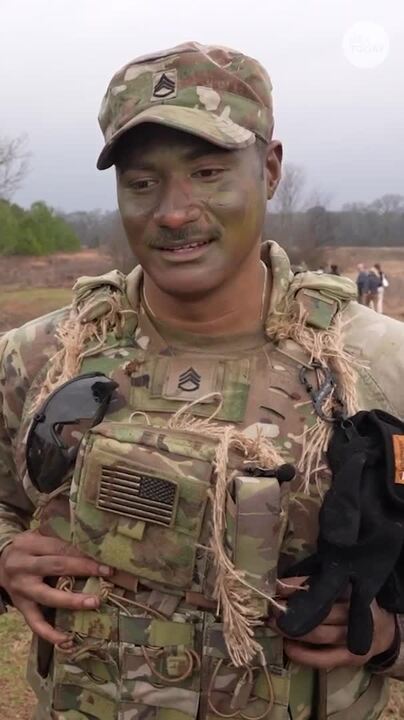
Staff Sergeant Salilo Fano at the Army Best Drone Warfighter Competition on Feb. 19, 2026 in Huntsville, Ala." style="max-width:100%; height:auto; border-radius:6px; margin:10px 0;" loading="lazy" />


Soldiers showcase skills in Army drone warfighter competition
A new Army drone warfighter competition in Huntsville, Ala tests soldiers' skills in racing drones through a challenging course and using "hunter-killer tactics."Staff Sergeant Salilo Fano at the Army Best Drone Warfighter Competition on Feb. 19, 2026 in Huntsville, Ala.
"It's not as easy as it looks," Staff Sgt. Salilo Fano, 31, one of the soldiers, told USA TODAY after the competition ended. One thing that helps "a lot" with training, he said, is playing video games.

The Army's first-of-its-kind drone warfighter competition this month comes amid a sweeping effort by the Pentagon toembed drones in every branchof the military. The event highlights a skill set some of these young soldiers honed long before they put on a uniform. The Army needs adept drone operators, and one thing the best pilots often have in common, Army leaders say: a knack for gaming.
"Were you a good video gamer? Do you build drones in your basement for fun? What made you have this passion, this desire to be good at this?" This is what the Army is asking as it searches for the next generation of recruits who can deftly operate drones, said Col. Nicholas Ryan, a member of Pentagon chiefPete Hegseth's "drone dominance team" and the Army lead for the Huntsville competition.
The mid-February event kicked off under gray skies on the University of Alabama's drone testing range.
On an obstacle course at the center, drones roughly the size of a microwave oven whizzed through circular plywood cutouts, backflipped over shipping carts, dodged an all-terrain vehicle and slalomed through a set of columns. From a tent on the side, a pair of soldiers delivered their best sports commentator impressions.
"And we're off," one said, "the first round moving aggressively through the yellow obstacle, those competitors sail through... over the Humvee and through our last obstacle, folks."

The crowd sporadically responded with cheers and oohs. Many drones sputtered to the ground before they crossed the first hurdle or crashed spectacularly into a wall.
Meanwhile, Fano, from American Samoa, and his partner, Sgt. Carter Shook, 22, a Pennsylvania native, were competing as a team in another event where soldiers race against the clock to smear camouflage paint on their faces, hoist water bottles over their heads, run sandbags up and down a stretch of land, and then hustle about a mile across the muddy turf with their drones strapped to their backs. The soldiers darted out from the trees, dropped their drones on a launchpad and sent them whizzing into the sky. Then they rushed back to their operating spot, scribbling notes on a pad and flipping on goggles to check their flight path.
"I haven't slept in 48 hours," one soldier told another as they prepared to start the competition. "As soon as I finish this, I faceplant."
The 200-plus competitors included soldiers who'd first touched a drone months prior and seasoned veterans who'd spent more than a decade piloting drones in various settings. One competitor, a member of the Army Reserves, uses drones in his package-delivery civilian job. Another flew drones for 13 years as a personal hobby. Most who spoke to USA TODAY said gamers make better drone operators.
Spc. Evan De Silva, 28, a contender in the "hunter killer" competition, said he flew his first drone just months prior. "There are video games that you can use to help you get, not exactly like this, but pretty damn close," he said.

Gamers "will pick up flying these a lot faster than people that don't play video games," said Sgt. Cory Koehn, 25, a member of the Army's 5-month-old drone team based in Fort Rucker, Alabama.
The selective team was at the competition to sniff out recruits with drone-operator chops. During a recent recruitment drive, just 20 people were picked from more than 120 applicants, theArmy said.
Army rushes to get up to speed on drones
Hegseth and Army Secretary Dan Driscoll have ambitious goals for amping up the Army's drone program.The Armyaims to buy a million drones by 2028, compared with the current rate of roughly 50,000 purchases annually.
In recent years, critics in Washington and the defense industry have voiced growingconcerns that the U.S. militarylags far behind China in preparing for future wars in which humans will no longer be seated in the cockpit. In a nod to those critics, Trump signed an executiveorderlast June aimed at "unleashing drone dominance," and Hegseth issued amemoshortly thereafter rescinding "restrictive policies that hindered production and limited access" to drones.
The military's plans to combat drones came into sharp focus this month after drone disputes at the southern border triggered two airspace closures in Texas, just weeks apart. In mid-February,aviation officials suddenly shut downthe El Paso airspace after border officials fired a military laser meant to take out threatening drones at an object that turned out to be a party balloon. Two weeks later,the airspace around Fort Hancock, about 50 miles southeast, was shut down after the military used the device to shoot a drone that ended up belonging to Customs and Border Protection.
Military leaders are also watching the war in Ukraine with a growing sense of urgency. First Person View, or FPV drones – the type used in the Army drone competition – have dominated the battlefield in Ukraine, as it has sought, for the past four years, to fend off Russia's more substantial military.
Advertisement

In Ukraine, the gamification of drone warfare has been far more explicit. Ukraine's military has created a drone "bonus system" in which drone operators areawarded pointsfor wounding and killing Russian troops that they can exchange for new weapons on anAmazon-like online marketplace.
This concept is not new in the United States, where the military maintains a mutually beneficial relationship with gaming companies and communities.
For decades, military services haveused simulatorsbased on commercially available video games to train soldiers. During the last fiscal year, the Army spent roughly $10.1 million on "gaming technology in support of Army training," according to budgetdocuments. Military handsets to control weapons systemsare modeled onXbox and PlayStation controllers.
Branches of the military each have their ownesports teamsthat compete against one another and in wider competitions with civilian teams. The militaryaims to recruityoung people through its gaming content on streaming platforms such as Twitch and ads that resemble popular teen games. (The Army's Twitch channel stirred controversy in 2020 when itbanned userswho asked questions in gaming chats about war crimes.)
The gaming industry, in turn,hires retired generalsas advisors andsells equipmentperfected by commercial designers to the military. In Call of Duty, the iconic and realistic military game, players can net a "hunter killer" drone as a reward for racking up roughly six "kills."

The Pentagon and the gaming industry "use each other opportunistically," said Matthew Thomas Payne, an associate professor at the University of Notre Dame who studies gaming culture and authored "Playing War: Military Video Games after 9/11."
The video game industry "will look at the military and say, 'What kinds of assets can you provide us so that we can make our games more realistic?'" he said.
"The military sees the video game industry as soft power. It's a way of leveraging popular culture to win hearts and minds."
Wayne Phelps, a retired Marine Corps Lieutenant Colonel and author of "On Killing Remotely: The Psychology of Killing with Drones," said it makes sense that the military would recruit gamers with transferable skills, such as good hand-eye coordination and the ability to multitask, to be drone operators.

"It's how you would recruit anybody for a job," said Phelps, who commanded a drone squadron on counterterrorism operations.
In interviews for Phelps' book, drone pilots told him that they "rejected the notion that they didn't understand what they were doing was real" and "understood that they're often using lethal force and taking human lives."
Drone pilots can suffer visceral, real-life trauma from afar
As the Pentagon and the defense industry rush to embrace drones and recruit skilled young people to operate them, the well-being of drone operators is often ignored, said Tanner Yackley, a retired Air Force drone pilot who founded Remote Warrior, a mental health advocacy organization for drone pilots.

"You have all these people in industry pushing, looking at what's the end goal, and you're skipping... the human in the loop," he said.
Quick reflexes developed from a gaming hobby might lend themselves to operating a drone, Yackley said. But video games were nothing like his experience of remote warfare around the world, including in Afghanistan, from thousands of miles away at Holloman Air Force base in Las Vegas.
"That job chewed me up and spit me out," he said.
Yackley described the visceral experience of his four-year stint flying daily remote combat missions during the height of the War on Terror – sleeping two hours a night and working for seven, rewatching bloody footage of drone kills dozens of times over, suffering from "nervous system fragmentation" caused by always having a finger on the trigger. Viewing him as a "desk job" worker, Yackley said, veterans' doctors dismissed his debilitating post-traumatic stress.
Multiplestudieshavefoundthat drone crews suffer from intrusive thoughts, depression, problems in their personal relationships and "moral injury." Although this year's defense policy bill included a provision that the Pentagon must study the mental health impact of drone warfare on operators, Yackley said it was "too little, too late."
From thousands of miles away, at a safe post in the United States, Yackley witnessed the horrors of war unfolding. "In 2012, I watched a wife drag half her husband across a courtyard. I was 19 at the time," Yackley said. "That's what nobody's preparing for, because we all want to put this silly video game spin on it."
"What happens when they flip the goggles up and go, 'I just killed this guy'?"
This article originally appeared on USA TODAY:Are gamers better at flying a drone? The Army wants to find out.