Winter storms blanket the East, while the US West is wondering: Where's the snow?

Ski season is here, but while the eastern half of the U.S.digs out from wintery storms, the western U.S. snow season has been off to a very slow start.

The snowpack wasfar below normalacross most of the West on Dec. 1, 2025. Denver didn't see its first measurable snowfall until Nov. 29 – more than a month past normal, and one of itslatest first-snow dates on record.

But a late start isn't necessarily reason to worry about the snow season ahead.

Adrienne Marshall, ahydrologist in Coloradowho studies how snowfall is changing in the West, explains what forecasters are watching and how rising temperatures are affecting the future of the West's beloved snow.
NOAA

What are snow forecasters paying attention to right now?

It's still early in the snow season, so there's a lot of uncertainty in the forecasts. A late first snow doesn't necessarily mean a low-snow year.

But there are some patterns that we know influence snowfall that forecasters are watching.

For example, the National Oceanic and Atmospheric Administrationis forecasting La Niña conditions for this winter, possibly switching to neutral midway through. La Niña involves cooler-than-usual sea-surface temperatures in the Pacific Ocean along the equator west of South America. Cooler ocean temperatures in that regioncan influence weather patternsacross the U.S., but so can several other factors.

Chart: The Conversation/CC-BY-ND, Source: NOAA

La Niña – and its opposite, El Niño – don't tell us what will happen for certain. Instead, they load the dice toward wetter or drier conditions, depending on where you are. La Niñas aregenerally associatedwith cooler, wetter conditions in the Pacific Northwest and a little bit warmer, drier conditions in the U.S. Southwest, but not always.

When we look at the consequences for snow, La Niña does tend to mean more snow in the Pacific Northwest and less in the Southwest, but, again, there's a lot of variability.

USDA Natural Resources Conservation Service

Snow conditions also depend heavily on individual storms, and those are more random than the seasonal pattern indicated by La Niña.

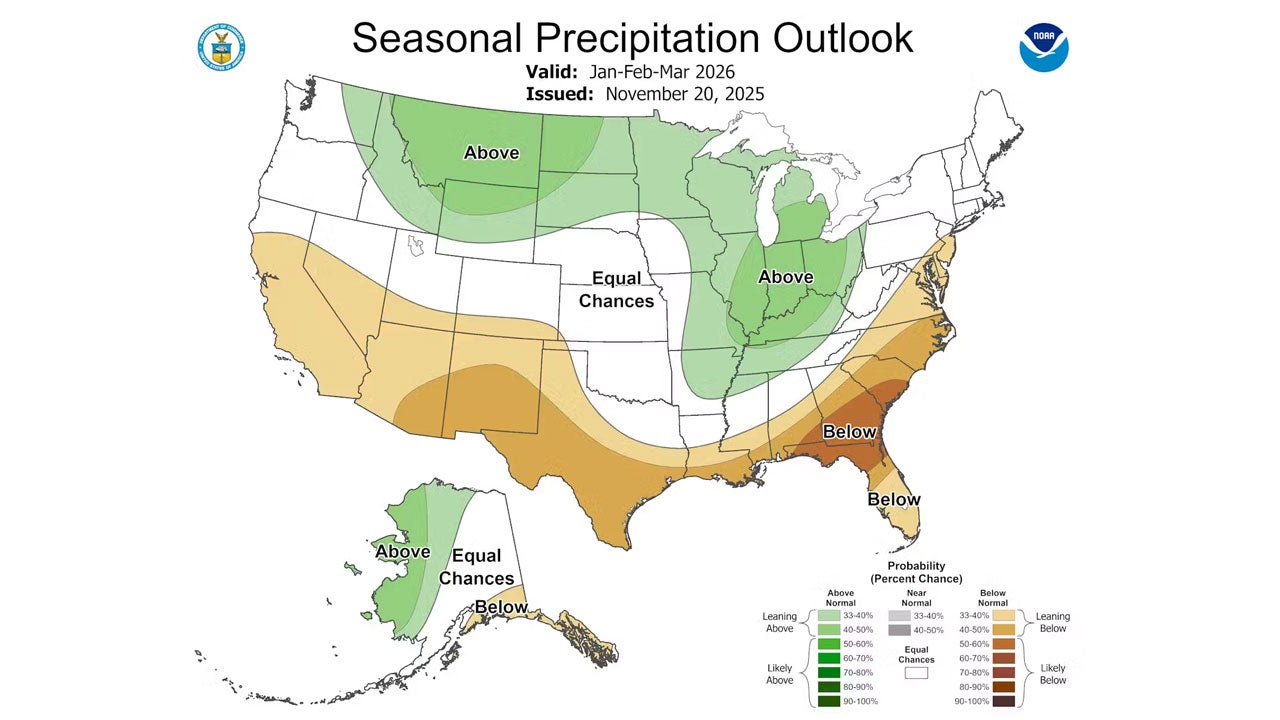
If you look atNOAA's seasonal outlook maps, most of Colorado and Utah are in the gap between the cooler and wetter pattern to the north and the warmer and drier pattern to the south expected during winter 2026. So, the outlook suggests roughly equal chances of more or less snow than normal and warmer or cooler weather across many major ski areas.

How is climate change affecting snowfall in the West?

In the West, snow measurements date back a century, so we can see some trends.

Starting in the 1920s, surveyors would go out into the mountains andmeasure the snowpackin March and April every year. Those records suggestsnowfall has declinedin most of the West. We also see evidence ofmore midwinter melting.

How much snow falls is driven by both temperature and precipitation, andtemperature is warming.

Chart: The Conversation, CC-BY-ND, Source: NOAA

In the past few years, research has been able todirectly attribute observed changesin the spring snowpack to human-caused climate change. Rising temperatures have led to decreases in snow, particularly in the Southwest. The effects of warming temperatures on overall precipitation are less clear, but the net effect in the western U.S. is a decrease in the spring snowpack.

When we look atclimate change projections for the western U.S.in future years, we see with a high degree of confidence that we canexpect less snow in warmer climates. In scenarios where the world produces more greenhouse gas emissions, that'sworse for snow seasons.

Should states be worried about water supplies?

This winter's forecast isn't extreme at this point, so the impact on the year's water supplies is a pretty big question mark.

Snowpack – how much snow is on the ground in March or April –sums up the snowfall, minus the melt, for the year. The snowpack also affects water supplies for the rest of the year.

TheWest's water infrastructure systemwas built assuming there would be a natural reservoir of snow in the mountains. California relies on the snowpack forabout a thirdof its annual water supply.

However, rising temperatures are leading toearlier snowmelt in some areas. Evidence suggests that climate change is also expected to causemore rain-on-snow eventsat high elevations, which can cause very rapid snowmelt.

Luis Sinco/Los Angeles Times via Getty Images

Both create challenges for water managers, who want to store as much snowmelt runoff as possible in reservoirs so it's available through the summer, when states need it most for agriculture and for generating hydropower to meet high electricity demand. If the snow melts early, water resource managers face some tough decisions, because they also need to leave room in their reservoirs to manage flooding. Earlier snowmelt sometimes means they have to release stored water.

When we look at reservoir levels in the Colorado River basin, particularly the big reservoirs – Lake Powell and Lake Mead – we see apattern of decline over time. They have had some very good snow and water years, and also particularly challenging ones, including along-running drought. The long-term trends suggest an imbalance between supply andgrowing demand.

Chart: The Conversation, CC-BY-ND, Source: U.S. Bureau of Reclamation

What else does snowfall affect, such as fire risk?

During low-snow years, the snowpack disappears sooner, and thesoils dry out earlierin the year. That essentially leaves a longer summer dry period andmore stress on trees.

There is evidence that we tend to havebigger fire seasons after low-snow winters. That can be because the forests are left with drier fuels, which sets the ecosystem up to burn. That's obviously a major concern in the West.

Snow is also important to a lot of wildlife species that are adapted to it. Oneexample is the wolverine, an endangered species that requires deep snow for denning over the winter.

What snow lessons should people take away from climate projections?

Overall, climate projections suggest our biggest snow years will beless snowy in anticipated warmer climates, and thatvery low snow yearsare expected to be more common.

But it's important to remember that climate projections arebased on scenariosof how much greenhouse gas might be emitted in the future – they are not predictions of the future. The worldcan still reduce its emissionstocreate a less risky scenario. In fact, while the most ambitious emissions reductions are looking less likely, theworst emissions scenarios are also less likelyunder current policies.

Understanding how choices can change climate projections can be empowering.Projections are saying: Here's what we expect to happen if the world emits a lot of greenhouse gases, and here's what we expect to happen if we emit fewer greenhouse gases based on recent trends.

The choices we make will affect our future snow seasons and the wider climate.

This article has been updated to correct the references to Denver, which saw one of its latest snowfalls on record.

Adrienne Marshall, Assistant Professor of Geology and Geological Engineering, Colorado School of Mines

Winter storms blanket the East, while the US West is wondering: Where’s the snow?

Ski season is here, but while the eastern half of the U.S.digs out from wintery storms, the western U.S. snow season has ...
Debris is piled up at the entrance to Camp Mystic on July 7, 2025 in Hunt, Texas. (Brandon Bell / Getty Images file)

Camp Mystic has announced its plan to reopen next summer with new safety measures aftermore than two dozen people were killed in floodsat the all-girls Texas summer camp earlier this year.

Twenty-seven children and camp counselors died after slow-moving thunderstorms in Kerr County caused the Guadalupe River to flood.

In a message to parents issued Tuesday, the camp said it is preparing for next summer's event at their newer Cypress Lake location, which is "completely independent from the older Guadalupe River camp, with a separate entrance, waterfront, dining hall, office, pavilion, infirmary, playing fields, archery range, stables, chapel, and cabins," according to their website.

The camp said it has taken steps to enhance security at the location, including installing over 100 flood monitoring units along Cypress Lake and the South and North forks of the Guadalupe River.

"The system will provide early detection of high-water events, as it communicates for miles with other sensors using LoRaWAN (low-range wide-area network) technology, allowing campers, counselors and staff to respond and quickly and safely evacuate to an elevated muster station," the camp said.

An officer prays with a family as they pick up items at Camp Mystic in Hunt, Texas on Wednesday, July 9, 2025.  (Ashley Landis / AP)

Hand-held two-way radios with weather alerts from the National Oceanic and Atmospheric Administration will be added to each cabin, and the camp's internet will be backed up with satellite internet, the camp said. The campdoes not allow attendees to have their phones, and cell service at the Guadalupe camp earlier this year was reportedly spotty.

The camp will also add "higher-capacity generators to maintain power in critical areas," like the office and dining hall.

"These enhancements will also help us maintain communication with emergency personnel and parents in the event of an emergency," the camp said in the message.

The 2026 camp dates start on May 30 and end on Aug. 9, designating 10-day stints for girls of different ages, the camp said. Enrollment has not yet opened.

On the morning of July 4, the Guadalupe River in Kerr Countyoverflowed as a result of consistent rainfall, putting Camp Mystic attendees asleep in their cabins at risk.

"We recognize that returning to Camp Mystic carries both hope and heartache," the camp acknowledged in the message to parents. "For many of your daughters, this return is not simple, but it is a courageous step in their healing journey."

The camp is also offering tours of the Cypress Lake location in April where families can ask questions.

Camp Mystic to open with new safety plan after 27 kids and counselors died in Texas floods

Camp Mystic has announced its plan to reopen next summer with new safety measures aftermore than two dozen people were killed in floodsat t...
The skyline of Minneapolis is seen on March 26, 2021. - Joshua Lott/The Washington Post/Getty Images

A new Immigration and Customs Enforcement operation in Minneapolis and St. Paul, Minnesota, will target undocumented Somali immigrants, a federal official told CNN on Tuesday, as the president has ramped up attacks against the community in recent days.

The New York Times,which cited documentsand an official who spoke anonymously, was first to report the operation in Minneapolis.

The latest federal immigration effort comes as President Donald Trump ended his Cabinet meeting on Tuesday by asserting he does not want Somali immigrants in the United States. He referred to the community and Minnesota Democratic Rep. Ilhan Omar, a Somali immigrant, as "garbage" who should "go back to where they came from."

"I don't want them in our country," he said. "Their country is no good for a reason. Their country stinks, and we don't want them in our country."

The president's remarks represent an escalation of his attacks against Somalis, particularly in Minneapolis. He has repeatedly singled out Somalis since last week's shooting of two National Guard members in Washington, DC, even though the alleged shooter is an Afghan who had nothing to do with Somalia.

Somalia is one of 19 countries included in Trump's sweeping travel ban, which imposes full or partial restrictions. Many of the countries on the list are either failed states or under repressive rule, and some are governed by groups that took control after years of US involvement,CNN has reported.Trump has described Somalia as a country that has "no laws, no water, no military, no nothing."

The president's hostile rhetoric toward Somali refugees and Rep. Omar stretches back years. Since his first term, he has zeroed in on the Minnesota's Somali population to tout his agenda to crack down on immigration.

In a statement, Department of Homeland Security Assistant Secretary Tricia McLaughlin said the agency does "not discuss future or potential operations."

Leaders of the Twin Cities called a news conference Tuesday to respond to reports of the new ICE operation in the area, saying they were not given advance notice or information about the plan.

"To our Somali community, we love you and we stand with you," Minneapolis Mayor Jacob Frey said. "Minneapolis is proud to be home to the largest Somali community in the entire country." Frey confirmed Minneapolis police would not participate in immigration enforcement operations.

Similarly, St. Paul Mayor Melvin Carter said "The last thing we need is federal agents coming in town to create chaos and challenge for us." Both mayors reiterated their citizens have rights and touted immigration legal resources available to the community.

Minneapolis City Council member Jamal Osman, a Somali immigrant who represents many migrants in his district, said his community "has lived through fear in the past, and we are not going to let that divide us."

"I know many families are fearful tonight, but I want you to know that city, Minneapolis stands behind you," Osman said at the news conference.

In response to the Times' report, Minnesota Gov. Tim Walz, a Democrat, called the proposed operation a "PR stunt."

"We welcome support in investigating and prosecuting crime," Walz posted on X. "But pulling a PR stunt and indiscriminately targeting immigrants is not a real solution to a problem."

This story has been updated with new developments.

CNN's Emma Tucker and Michael Williams contributed to this report.

For more CNN news and newsletters create an account atCNN.com

ICE to launch operation targeting Somali immigrants in Twin Cities, federal official says, as Trump calls community ‘garbage’

A new Immigration and Customs Enforcement operation in Minneapolis and St. Paul, Minnesota, will target undocumented Somali immigrants, a f...
Carl Rinsch Netflix Fraud Trial Begins: Was Sci-Fi Director a Swindler or Just in Over His Head?

"Our objective today is to figure out the nature of this project and what we must do to contain it."

The line is from the trailer to "White Horse," which got its unofficial debut on Tuesday at the federal trial of director Carl Rinsch, who is accused of swindling Netflix out of millions in the course of the boondoggle production.The show, which was never completed, was pitched to the streamer as a high-concept thriller about the rise of humanoid OI's (organic intelligences) and the human factions determined to destroy them. Described as a mix of "Star Wars," "Westworld" and "The Matrix," the series was once touted by Netflix execs as their next big franchise.But those dreams faltered when the big-budget series began to face major production issues in the fall of 2019. Netflix tried to solve the problems by sending Rinsch an additional $11 million. That was March 2, 2020 — just before the pandemic disrupted nearly every production. Netflix never saw any additional footage or material for "White Horse" and ultimately wrote off its entire investment.Over five years later, Rinsch, 48, is facing many years behind bars if convicted of wire fraud, money laundering and making a series of illegal transactions. The "47 Ronin" filmmaker is alleged to have used the $11 million for his own benefit, buying a $740,000 Ferrari, a $340,000 watch and four luxury mattresses totaling $638,000, among other purchases.

More from Variety

"This is a case about greed and lies," the prosecutor told the jury, saying Rinsch "saw an opportunity to make a killing" in the stock market at the start of the pandemic and "deceived" multiple employees at Netflix to get the $11 million. "And Netflix paid because they continued to believe in the project."

Prosecutors say Rinsch routed the money through multiple bank accounts before moving it into his personal brokerage account. He then "went on a spending spree," they alleged.

The government told jurors they'll "be able to follow the money" through testimony from witnesses Rinsch allegedly deceived, including his financial manager, personal assistant, bookkeeper and editor. Several Netflix executives, including Cindy Holland, who is now head of streaming at Paramount, are also expected to take the stand.

Defense attorney Michael Arthus offered a more favorable portrayal in his opening statement, painting Rinsch as an artist embroiled in a contract dispute — not a criminal. Arthus called him a "luminary and visionary who can breathe new light into a universe that doesn't exist" — but suggested he was in over his head as a producer.

"The artist Carl valued the story more than the producer Carl worried what it would cost," Arthus said.

The lawyer also blamed "executive group think" and the pandemic for pushing the project off the rails.

"He was Vincent van Gogh with a Netflix deal struggling with his benefactor," Arthus concluded. "This is the story of a creative genius… He couldn't quite deliver, but that doesn't make him a fraud."

Rinsch scribbled notes in a yellow legal pad during opening statements.

Peter Friedlander, whorecently leftNetflix tobecomehead of global television at Amazon MGM Studios, was the first witness to testify. He and Holland were the two main execs who acquired "White Horse," alongside producers Keanu Reeves, Rian Johnson and Gabby Roses, who is Rinsch's ex-wife. He testified about the project's initial presentation, saying Rinsch brought him five to six short episodes that were "visionary." The trailer was played for the jury, which featured Cronenberg-esque body horror and finished visual effects.

While Rinsch's original pitch outlined 13 episodes with runtimes of four to 14 minutes, Friedlander set forward a plan to shoot a significant amount of new footage, requiring Rinsch to expand his story and add new characters into the mix. On Sept. 9, 2019, he received an email outlining production problems.

"The problem, in this case, is a simple one of money," Rinsch wrote. "Which is a reality I have to face. And manage."

Rinsch outlined two options: to "protect and survive" and limit financial exposure or "forge ahead" and continue to increase the budget. Friedlander was committed to the vision for the series and its potential as a franchise. "The show was at a crisis point at this point," he said on the stand. "We were investing in this to tell the entire story… To end it right before the end would create a terrible, unsatisfying customer experience."

Friedlander took a more hands-on approach, directing Rinsch to submit detailed production reports going forward. He flew to the troubled Budapest set in October 2019 with another Netflix executive, Mike Posey. Reflecting on the experience, he said, "We wanted to be thought partners and better understand the shooting challenges."

In February 2020, emails showed that Rinsch outlined a roadmap to condense the production timeline and get the project back on track. On March 4, 2020, he was sent $11 million to spend on storyboards, production designs, fabrication of art/costumes, pay or play on key crew and artists, editing of existing material and other production costs in a five-week period. Although the pandemic paused a lot of filming for various projects, Friedlander asserted that Rinsch could've continued working on the project.

Around that time, Rinsch gifted Friedlander a lavish coffee table book with production photos of the 2019 shoot. It was the last material on "White Horse" Friedlander ever received.

Judge Jed Rakoff told jurors he expects to be wrapped before the end of next week.

Best of Variety

Sign up forVariety's Newsletter. For the latest news, follow us onFacebook,Twitter, andInstagram.

Carl Rinsch Netflix Fraud Trial Begins: Was Sci-Fi Director a Swindler or Just in Over His Head?

"Our objective today is to figure out the nature of this project and what we must do to contain it." T...
When is the 'South Park' Season 28 finale? What fans need to know.

Following a season full ofjokes towards the Trump administration, Season 28 of Comedy Central's "South Park" is coming to an end.

The fifth episode will mark the season finale of the long-running comedy series, which, much like the previous season, has parodied the Trump administration through quips and digs, including a shockingfictional love scene involving President Donald Trump and Vice President JD Vanceand a mocking portrayal of Secretary of Homeland SecurityKristi Noem.

White House spokesperson Taylor Rogersresponded in July,saying that the long-running show "hasn't been relevant for over 20 years and is hanging on by a thread with uninspired ideas in a desperate attempt for attention."

Love it or hate it, here's what to know about the Season 28 finale of "South Park" and how to watch it.

What time does Season 28, Episode 4 of 'South Park' air?

Barring any further delays, Season 28, Episode 4 of "South Park" is scheduled to air on Wednesday, Dec. 10, at 10 p.m. ET/PT on Comedy Central.

The episode will also be available to stream on Paramount+ the following day, Thursday, Dec. 11, at 6 a.m. ET/3 a.m. PT, according to the streaming platform.

Screenshot from the Season 28 episode of

How to watch new episodes of 'South Park'?

New episodes of "South Park" air on Comedy Central and are available to stream on Paramount+.

Paramount+ offerstwo subscription plans:

  • Paramount+ Essential is $7.99 per month and provides access to thousands of episodes, movies and live NFL on CBS (with limited ads).

  • Paramount+ Premium is $12.99 per month and includes everything in the Essential plan plus Showtime originals, blockbuster movies and live TV with fewer ads.

Fernando Cervantes Jr. is a trending news reporter for USA TODAY. Reach him at fernando.cervantes@gannett.com and follow him on X @fern_cerv_.

This article originally appeared on USA TODAY:'South Park' Season 28 finale airs soon. Here's how, when to watch.

When is the 'South Park' Season 28 finale? What fans need to know.

Following a season full ofjokes towards the Trump administration, Season 28 of Comedy Central's "South Park...
Quentin Tarantino Reveals His Top 10 Picks for Best Movies of the 21st Century

If anyone's qualified to judge whichmoviesserve as the best the 21st century has to offer, it'sQuentin Tarantino.

The iconic filmmaker behind such legendary hits asPulp Fiction, Inglourious Basterds, Kill BillandDjango Unchained, the 62-year-old Tarantino has long expressed an undying love for all things cinema.

With that in mind, it's no great surprise that theOnce Upon a Time in Hollywooddirector has once again entered the public spotlight with his list for the best films of the 21st century.

Appearing on a recent episode ofThe Bret Easton Ellispodcast, Tarantino finished off his ongoing countdown to thebest moviesof the current century, topping off the list with Ridley Scott's 2001 war film,Black Hawk Down.

Based on the 1999 nonfiction book of the same name,Black Hawk Downfocuses on the real-life military operations pitting a United States military task force against Somali insurgents in 1993 Mogadishu.

Led by an expansive ensemble cast that includes the likes of Josh Hartnett, Ewan McGregor, Jason Isaacs, Tom Hardy, Orlando Bloom, Sam Shepard,Tom Sizemoreand Eric Bana,Black Hawk Downearned a number of positive reviews upon its initial release, although it failed to gain serious traction at the 74thAcademy Awards.

Over 20 years since the movie's theatrical debut, however, Tarantino is heaping praise on Ridley Scott's war film, calling it "beyond extraordinary."

"I liked it when I first saw it, but I actually think it was so intense that it stopped working for me, and I didn't carry it with me the way that I should've," Tarantino said of the film. "Since then, I've seen it a couple of times, not a bunch of times, but I think it's a masterwork, and one of the things I love so much about it is […] this is the only movie that actually goes completely for anApocalypse Nowsense of purpose and visual effect and feeling, and I think it achieves it."

"It keeps up the intensity for 2 hours 45 minutes, or whatever it is, and I watched it again recently, my heart was going through the entire runtime of the movie," the director continued. "It had me and never let me go, and I hadn't seen it in a while. The feat of direction is beyond extraordinary."

Tarantino's other picks for the top 10 films of the century included:

  1. Black Hawk Down

  2. Toy Story 3

  3. Lost in Translation

  4. Dunkirk

  5. There Will Be Blood

  6. Zodiac

  7. Unstoppable

  8. Mad Max: Fury Road

  9. Shaun of the Dead

  10. Midnight in Paris

This story was originally published byParadeon Dec 2, 2025, where it first appeared in theNewssection. Add Parade as aPreferred Source by clicking here.

Quentin Tarantino Reveals His Top 10 Picks for Best Movies of the 21st Century

If anyone's qualified to judge whichmoviesserve as the best the 21st century has to offer, it'sQuentin Tarantino....
Nevada governor signs sweeping crime bill as state looks to boost tourism

LAS VEGAS (AP) — Nevada Gov. Joe Lombardo signed his sweeping crime package into law over the weekend that will help revive a unique court program that barred offenders of some crimes from the Las Vegas Strip and will stiffen penalties for smash-and-grab robberies, DUIs, and assault and battery against hospitality workers.

Known as the Safe Streets and Neighborhoods Act, the law paves the way for the reinstitution of the controversial Resort Corridor Court to penalize crimes such as petty theft, assault, drug offenses and loitering originating on the Las Vegas Strip and coinciding with orders banning people from the tourist area for a year.

The bill's passage marked a major political win for the Republican governor as he prepares for a challenging reelection campaign in 2026. His race is one of the most competitive in the country, and recent polling shows him and his likely opponent Democrat Attorney General Aaron Ford neck-and-neck.

Resort Corridor Court revival still faces hurdles

Resort lobbyists and the union representing hospitality workers — both political powerhouses — teamed up to see the Resort Corridor Court reopened, arguing it will improve safety and protect the visitor-friendly reputation of the state's key tourist attraction amid a slump in tourism.

Between June 2024 and June 2025, the Las Vegas Convention and Visitors Authority reported an 11% decline in visitors.

Opponents question its legality and say the orders unfairly target homeless people.

"We greatly appreciate Governor Lombardo and legislative leadership for working together to advance this important tourism-safety legislation," said Virginia Valentine, the president and CEO of the Nevada Resort Association, in a Tuesday statement, adding that the court will ensure Las Vegas remains a premier tourism destination.

The law authorizes the Clark County Commission to revive the court, but it is unclear when – or if – the commission will take up the issue.

Jennifer Cooper, a spokesperson for the county, said it is premature for the commission to engage at this point because the discretion to revive the court lies with the Justice Court. The court did not return requests for comment.

Nevada judges instituted the court two years ago, but they voted to disband it a year and a half later.

If the court program is revived, litigation challenging its legality is expected, according to Athar Haseebullah, executive director of the ACLU of Nevada, which has been a staunch opponent of the court.

"There will continue to be pushback by our organization and by so many others who don't want to see this continued creep of privatization of our judicial system," he said in a phone interview.

Bill also bars immigration enforcement inside schools

The bill also included amendments prohibiting immigration enforcement officers from entering school grounds without a warrant and requiring detention facilities to maintain a running list of the people they hold.

Nevada joins states like California and Maryland in enacting laws restricting federal immigration enforcement officers from accessing school property without a warrant.

Democratic lawmakers in Nevada put forward a proposal in the last regular session to bar immigration officials from school grounds without a warrant, but Lombardo vetoed it, calling it "well-intentioned but fundamentally overbroad." Lombardo's office said the amendment Democrats added to his bill abides by the constitution and includes exceptions that allow law enforcement officers to keep schools safe.

Those exceptions include school resource officers and law enforcement who need to enter the property in case of an emergency, such as a school shooting.

It is the latest state effort to make immigration enforcement restrictions clear following a Trump administration announcement at the beginning of the year that it would allow federal immigration agenciesto make arrests at schools, churches and hospitals, ending a policy that had been in effect since 2011.

Cecelia González, a Democratic assemblymember who sponsored the original immigration bill, ultimately voted against the governor's crime package. She said she is happy that "students are finally being taken seriously about their real, lived fear" but overall thinks the bill will do more harm than good.

Nevada governor signs sweeping crime bill as state looks to boost tourism

LAS VEGAS (AP) — Nevada Gov. Joe Lombardo signed his sweeping crime package into law over the weekend that will help revi...


NEO MAG © 2015 | Distributed By My Blogger Themes | Designed By Templateism.com